

Opening a dispensary costs roughly $250,000 to $2 million, depending on your state and business model. Licensing, real estate, build-out and security, inventory, staffing, and a federal tax reserve drive most of the spend.
There is no single answer to how much it costs to open a dispensary: your state, your market, and your model (storefront, delivery, or vertical operation) drive most of the variance. What matters more than the headline figure is knowing every category you have to fund, because the costs that sink new operators are usually the ones they never budgeted for.
This guide breaks down every dispensary startup cost category, the figures we can trace to a primary source, and the line items almost everyone underestimates, so you can build a budget from your local numbers instead of a national midpoint.
In This Post
- Why the Cost to Open a Dispensary Varies So Much
- The Cost Categories to Budget For
- Typical Cost Ranges at a Glance
- The 280E Reserve: What Changed in 2026
- Where Smart Operators Spend
- How to Keep Startup Costs Under Control
- Common Questions
Key Takeaways
- Opening a dispensary in 2026 typically costs $250,000 to $2 million. The widely circulated "$700,000 for an average 1,800 square foot store" figure is a recycled industry estimate, not primary research, and build-out alone can exceed it.
- State retail license fees are modest in most Meadow states: a $1,500 application and $10,000 annual license in Massachusetts, $3,000 prequalification and $15,000 annual license in Michigan, $1,000 application and $7,000 license in New York, and $1,000 application plus a revenue-scaled $2,500 to $96,000 annual license in California, per each state regulator's fee schedule.
- Professional services, working capital, and the federal tax reserve are the lines most first-time budgets leave out.
- As of October 2026, Section 280E still applies in full to adult-use dispensaries. Relief covers only qualifying state-licensed medical activity, and formal IRS guidance has not been issued.

Why the Cost to Open a Dispensary Varies So Much
Two things drive most of the variance in dispensary startup costs: your state and your model. License fees, real estate, and competition differ enormously by state, and a single storefront, a delivery operation, and a multi-license vertical operation have very different cost structures. If you are weighing a delivery model, our complete operator's guide to cannabis delivery covers how that business works.
State fee schedules make the spread concrete. As of October 2026, a retail license costs a $1,500 application fee and $10,000 annual license fee in Massachusetts (Cannabis Control Commission), a $3,000 prequalification fee and $15,000 annual retailer license in Michigan (Cannabis Regulatory Agency), a $1,000 application fee and $7,000 retail dispensary license in New York (Office of Cannabis Management), and a $1,000 application fee plus an annual license fee that scales from $2,500 to $96,000 with gross revenue in California (Department of Cannabis Control).
Fees are rarely the biggest line. Limited-license states usually mean higher upfront costs to win and build, while mature, competitive markets put more pressure on margins once you are open. Our state guides for Massachusetts, Michigan, New York, and Minnesota walk through what each market actually demands.
Treat the categories below as buckets to fill with your local numbers.
 Build-out and security are routinely the largest line in a dispensary launch budget
The Cost Categories to Budget For
A dispensary launch budget has to fund eight categories. Four are one-time costs you pay to get open. Four are ongoing costs that start before revenue does, and those are the ones first-time budgets most often skip.
One-time costs to get open:
- Licensing and application fees. Application, licensing, and renewal fees set by your state regulator. In Meadow's states these are usually modest. Massachusetts waives application fees in full, and cuts license fees by half, for Social Equity Program participants and Economic Empowerment Priority Applicants. See our guides to opening a dispensary in Massachusetts, Michigan, New York, and Minnesota for each state's process.
- Real estate. Lease or purchase, often at a premium because compliant locations are scarce once zoning and proximity rules are applied. Expect larger deposits, personal guarantees, and above-market rent as a cannabis tenant. Rent itself is an annual operating cost, so model it against your ramp rather than your opening budget.
- Build-out and security. Construction, limited-access areas, secure storage, cameras, alarms, and access control to meet your state's security requirements. This is routinely larger than first-timers expect. A construction-cost estimate cited by CannDelta (February 2025) puts renovation and build-out at $350,000 to $3,500,000 and new construction at $900,000 to $3,500,000. Our guide to building a dispensary security plan covers what regulators actually look for.
- Inventory. Your opening product buy, plus reserve to restock as you learn what sells. Negotiating well here compounds for years: see 3 strategies to secure the best vendor deals for your dispensary.
Ongoing costs that start before revenue:
- Technology. POS, compliance, eCommerce, and hardware. Cutting corners here is where cheap gets expensive, because a weak POS produces compliance mistakes and downtime. Our complete guide to choosing a cannabis dispensary POS system walks through the evaluation, and what dispensaries actually pay for POS in 2026 covers real pricing.
- Professional services. Legal, accounting, compliance consulting, and business planning. There is no vendor-neutral published benchmark we would stand behind, so get quotes early. What we can say from working with new operators: most first-time budgets leave this line out entirely, and it is rarely small.
- Staffing. Hiring, training, and payroll before revenue ramps. Vangst's 2026 U.S. Cannabis Jobs Report benchmarks budtenders at $17 to $26 an hour and store managers at $65,000 to $110,000 a year. A store running one manager and four to six full-time budtenders lands roughly between $205,000 and $435,000 in annual base payroll before taxes and benefits, with high-wage markets like California and Massachusetts at the upper end. Budget the months of that figure you will carry before you open and during your ramp.
- Working capital. The cushion to operate at a loss for the first months, plus your tax reserve.
 Payroll starts before revenue does, which is what makes staffing easy to underbudget
Typical Cost Ranges at a Glance
Dispensary startup costs sit in wide planning brackets rather than at a fixed price, and most of the brackets that circulate online cannot be traced back to a primary source. Every figure below is one we opened and verified as of the writing of this article (October 2026).
| Cost Category | Verified Range | Source |
|---|---|---|
| Application fee | $1,000 to $3,000 across MA, MI, NY, CA | State regulator fee schedules |
| Annual retail license | $7,000 to $15,000 in MA, MI, NY; $2,500 to $96,000 in CA, scaled to revenue | State regulator fee schedules |
| Build-out: renovation | $350,000 to $3,500,000 | CannDelta, February 2025 |
| Build-out: new construction | $900,000 to $3,500,000 | CannDelta, February 2025 |
| Annual base payroll | $205,000 to $435,000 for one manager and four to six budtenders | Calculated from Vangst 2026 U.S. Cannabis Jobs Report benchmarks |
Real estate, opening inventory, and professional services are left out of the table on purpose. There is no vendor-neutral published benchmark for any of the three that we would stand behind, and a number you cannot source is a number you cannot plan on. Quote those three locally.
For the lines that are in the table, the brackets are deliberately wide. A limited-license storefront in a competitive market and a single store in an open-license state can sit at opposite ends of every one of them.
The 280E Reserve: What Changed in 2026
Federal tax treatment under Section 280E is the dispensary startup cost most first-time operators miss. Under Internal Revenue Code Section 280E, cannabis businesses have historically been barred from deducting most ordinary operating expenses, which pushes effective tax rates far above a normal retailer's and can produce a tax bill in a year that felt unprofitable.
That changed partially in 2026. On April 22, 2026, the Department of Justice signed a final order moving cannabis regulated under a qualifying state medical marijuana license, plus FDA-approved cannabis drug products, from Schedule I to Schedule III. The order was published in the Federal Register and took effect on April 28, 2026. Here is where that leaves a new operator's tax planning as of the writing of this article (October 2026):
- Adult-use only operations. Adult-use cannabis remains Schedule I, and 280E still applies in full. If you are opening an adult-use store, budget the reserve exactly as operators did before 2026.
- Medical-licensed operations. Treasury and the IRS have said forthcoming guidance is expected to lift 280E for qualifying medical activity for the full taxable year that includes the order's effective date. Medical operators also need a DEA registration to handle Schedule III marijuana. Formal IRS guidance has not been issued, though Treasury and the IRS added Section 280E guidance to their 2026-2027 Priority Guidance Plan, with no completion deadline attached.
- Dual-license operations. Treatment of commingled medical and adult-use activity is unsettled. Treasury has said forthcoming guidance will address expense allocation for businesses with both kinds of activity, and none had been issued as of the writing of this article.
Two separate proceedings are still moving. The DEA's administrative hearing on whether to reschedule cannabis more broadly has been stayed since September 29, 2026, and the chief administrative law judge has not issued his recommendation. Separately, on September 9, 2026, the U.S. Court of Appeals for the D.C. Circuit declined to pause the April order, so it remains in effect while legal challenges proceed.
The practical takeaway for a launch budget has not changed: build a tax reserve, model it quarterly, and assume the pre-2026 treatment unless your CPA confirms your license type qualifies for relief. For the full picture, our cannabis 280E tax guide covers how the rule works and the COGS lever that lowers the bill, what dispensaries need to know about Schedule III cannabis tracks where the proceedings stand, and our dispensary accounting guide for QuickBooks covers the bookkeeping that makes the reserve defensible.
This section covers federal tax and regulatory status as of October 2026 and is not tax advice. Have a cannabis CPA review your specific structure.
Where Smart Operators Spend
Ask an operator two years in what they would redo, and the answer is usually a system they bought on price. A POS that drops mid-transaction on a Saturday costs a weekend of sales. A compliance workflow that needs manual CSV uploads costs a staff member several hours a week, every week, plus the audit exposure when someone fumbles an entry. A security system that does not meet your state's spec costs you the inspection.
That is why experienced operators treat POS, compliance, and security as infrastructure rather than line items to trim, and why they hire at least a few people who have actually worked cannabis retail before.
Pricing out five separate vendors for POS, compliance, and eCommerce? Meadow combines POS, compliance, eCommerce, and inventory in one platform, so a new store is not stitching together integrations on opening day. Book a Call to Learn More
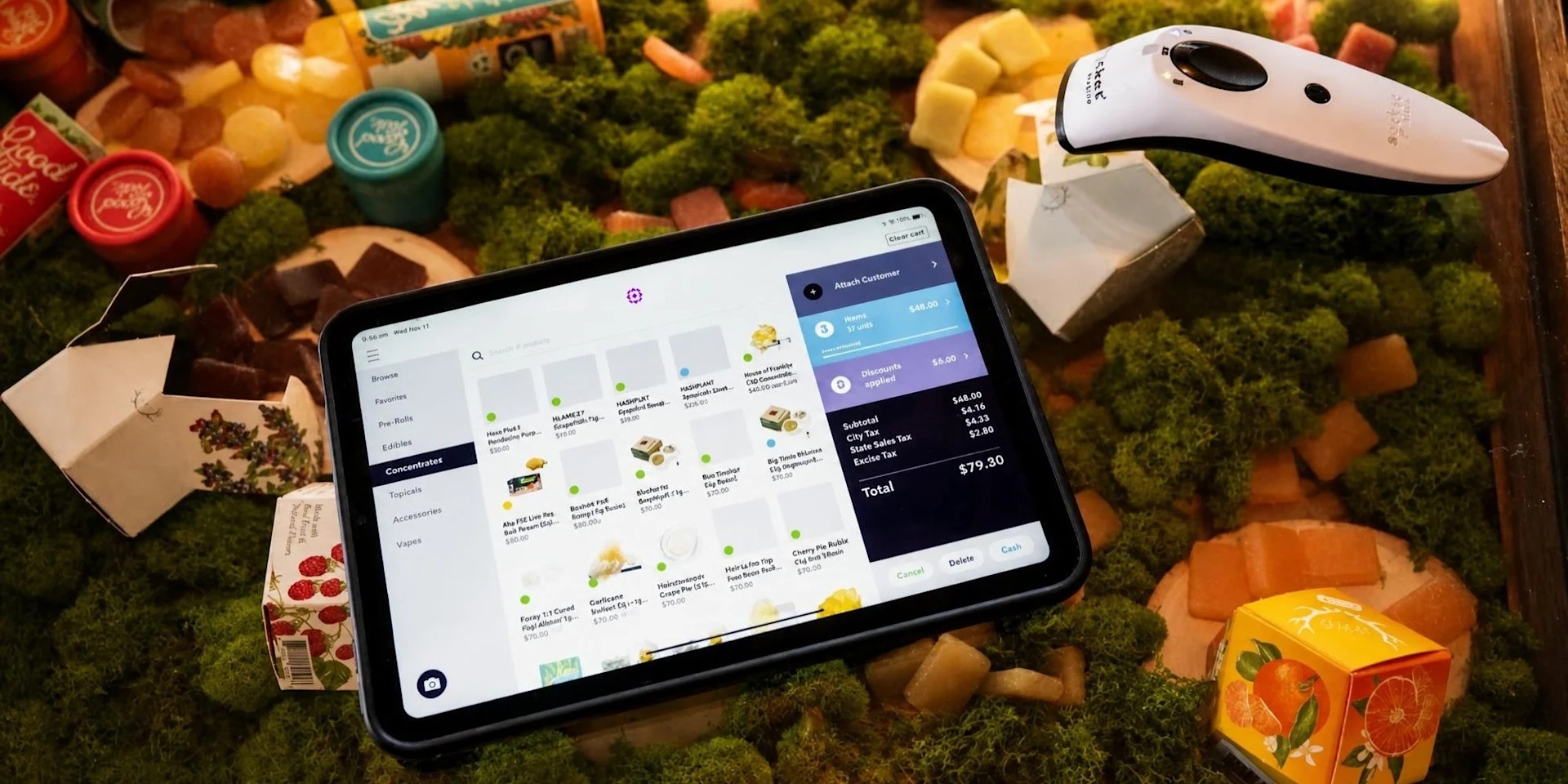 One platform for POS, compliance, inventory, and eCommerce
How to Keep Startup Costs Under Control
The most reliable way to keep dispensary startup costs under control is to avoid the expensive mistakes: signing a noncompliant lease, overbuilding before you open, and paying for tools you later have to replace.
Before you sign anything:
- Confirm your location passes zoning and proximity rules before signing a lease.
- Choose all-in-one technology so you are not paying for, and integrating, five separate vendors.
- Negotiate opening inventory hard and structure reorders around real sell-through data. Vendor deal strategies →
As you build and open:
- Phase non-essential build-out where regulations allow, and open lean.
- Plan promotions that protect margin from day one instead of discounting reactively. Dispensary discount strategy →
- Train staff fast with structured onboarding to shorten the unprofitable ramp. Our dispensary opening procedures checklist is a good starting SOP.
- Keep clean books from day one so you are ready for financing conversations and for whatever your tax treatment turns out to be.
💡 How Meadow handles this: Meadow's inventory and reporting tools show sell-through by product and category from your first week, so reorders and promotions are based on what your customers actually bought instead of your opening assumptions. See how Meadow tracks sell-through →
Common Questions
How much does it cost to open a dispensary?
Opening a dispensary typically costs from about $250,000 on the low end to $2 million in competitive, limited-license markets. Budget for licensing, real estate, build-out and security, inventory, technology, professional services, staffing, and 6 to 12 months of working capital, plus a federal tax reserve. Treat any single "average" figure with caution: the $700,000 number that circulates widely online traces back to a recycled industry estimate rather than primary research.
What's the most underbudgeted dispensary startup cost?
Working capital, professional services, and the federal tax reserve. Legal, accounting, and compliance consulting are routinely left out of first-time budgets, and Section 280E still disallows most deductions for adult-use operators, which makes the tax bill higher than a normal retailer's.
How much does a dispensary license cost?
It varies by state and license type. In Massachusetts, a Marijuana Retailer license is a $1,500 application fee plus a $10,000 annual license fee, with application fees waived for Social Equity and Economic Empowerment participants. Michigan charges $3,000 to prequalify and $15,000 a year, New York $1,000 to apply and $7,000 for the license, and California $1,000 to apply plus an annual fee of $2,500 to $96,000 scaled to revenue. Check your state regulator's current fee schedule, and see our Massachusetts, Michigan, New York, and Minnesota guides for those markets.
Does Section 280E still apply to my new dispensary in 2026?
It depends on your license type. Following the rescheduling order effective April 28, 2026, qualifying state-licensed medical marijuana activity is expected to be relieved of 280E for the 2026 tax year, while adult-use cannabis remains Schedule I and fully subject to it. As of October 2026, the IRS had not issued formal guidance and dual-license expense allocation was unsettled, so confirm your position with a cannabis CPA before budgeting around relief.
How much should I budget for dispensary technology?
Enough for a reliable, all-in-one POS with compliance built in. Cutting costs here produces compliance errors and downtime that cost far more than the software ever would. Our breakdown of what dispensaries actually pay for POS in 2026 covers real pricing ranges.
How long until a dispensary is profitable?
Plan for several months of operating at a loss while you ramp. A common planning convention is to hold 6 to 12 months of operating expenses in reserve. For a store carrying $205,000 to $435,000 in annual base payroll plus rent, that is a six-figure cushion. Size it against a slow ramp rather than a best-case one.
Opening a Dispensary? Talk to the Team That's Been Doing This Since 2014.
Meadow has been building cannabis retail software since 2014, when it became Y Combinator's first cannabis startup. Today Meadow powers dispensaries across California, New York, New Jersey, Michigan, Massachusetts, and Minnesota, with 99.999% uptime since 2014, more than $5B in retail orders processed, and a 4.9 out of 5 rating on G2 from 90+ verified reviews (July 2026). If you are planning a launch, we will show you how operators get open, compliant, and selling from day one.
More Resources for Dispensaries
- How to Open a Dispensary in Massachusetts
- How to Open a Dispensary in Michigan
- How to Open a Dispensary in New York: 2026 Guide
- How to Open a Dispensary in Minnesota
- How to Build a Dispensary Security Plan: 7 Expert Strategies
- Cannabis 280E Tax: What Every Dispensary Owner Should Know
- Cannabis POS Pricing: What Dispensaries Actually Pay in 2026
- Cannabis Delivery: The Complete Operator's Guide for 2026
