

California cannabis retailers collect the cannabis excise tax from their customers and remit it directly to the California Department of Tax and Fee Administration (CDTFA). That has been the rule since January 1, 2023, when the responsibility moved from distributors to retailers under AB 195.
If you hold a retailer or microbusiness retail license, the excise tax is money you collect on the state's behalf and hold until you file. The Cannabis Tax Law treats a late payment more harshly than most tax programs, with a mandatory minimum penalty of 50 percent.
This guide covers who collects and remits the tax, the permit you need, how and when to file, what happens when a payment is late, and which parts of the 2023 transition are now closed out.
In This Post
- Who Collects and Remits California's Cannabis Excise Tax
- What You Need Before You Can Collect
- How to File and Pay the Cannabis Retailer Excise Tax
- Penalties for Late or Unpaid Excise Tax
- What Has Changed Since 2023
- Closing Thoughts
- Common Questions

Who Collects and Remits California's Cannabis Excise Tax
The cannabis excise tax is imposed on the purchaser. The retailer collects it at the point of sale, reports it on a cannabis retailer excise tax return, and pays it to CDTFA.
That is a two step chain. Before January 1, 2023, it was three: distributors collected the excise tax from retailers, retailers built it into their prices, and distributors remitted to the state. Distributors stopped collecting the tax on January 1, 2023, and their cannabis tax accounts were closed out.
Any guidance describing a distributor collected excise tax is describing the pre 2023 model. If you are reading a vendor's tax explainer or an accountant's checklist and it references distributor remittance, it predates the current law.
The current chain looks like this:
- The customer pays the excise tax as part of the transaction total
- You show it as a separate line item on the receipt or invoice
- You report gross receipts and excise tax collected on your cannabis retailer excise tax return
- You pay CDTFA by the return due date
For how the tax itself is calculated, including what counts as gross receipts and how excise interacts with sales tax, see California Cannabis Excise Tax: How to Calculate It.
What You Need Before You Can Collect
You need a cannabis retailer excise tax permit from CDTFA. Retailers and microbusiness retailers licensed with the Department of Cannabis Control (DCC) were automatically registered during the 2023 transition, but a new license does not register itself.
Two points that trip up new operators:
- The excise tax permit is separate from your seller's permit. The cannabis retailer excise tax account is required in addition to your sales and use tax account. Two accounts, two returns.
- Applications run through CDTFA's online services portal. Per Cannabis Tax Regulation 3700, the application requires identifying, contact, business, ownership, and representative information.
If you are opening a new location under an existing license, confirm the location is registered on your sales and use tax account before you file, because the excise tax return reports gross receipts by site location.
💡 How Meadow handles this: Excise tax collected is broken out by location and reporting period in reporting, so a multi site operator pulls per location figures without reconstructing them by hand. Why Integrated Cannabis POS Software Is Essential for Compliance →
How to File and Pay the Cannabis Retailer Excise Tax
Cannabis retailer excise tax returns are filed electronically through CDTFA's online services portal, and they are due on or before the last day of the month following the reporting period.
- Reporting basis. New cannabis retailer excise tax accounts are generally assigned a quarterly reporting basis. Some accounts report monthly.
- Due dates. A first quarter period ending March 31 has a return due on or before April 30. The same pattern applies to each period.
- Zero activity still requires a return. A return must be filed for each reporting period even if there were no taxable transactions.
- Returns and refunds. When a customer returns product during the same period and you refund the full amount paid, that amount comes out of the gross receipts you report. A rehandling fee can be deducted and the refund still counts as full.
CDTFA publishes line by line filing instructions for the cannabis retailer excise tax return, which is the reference to work from at filing time rather than a summary.
Penalties for Late or Unpaid Excise Tax
The Cannabis Tax Law imposes a mandatory minimum penalty of 50 percent for failing to pay the cannabis excise tax due on or before the due date. This is the provision that makes cannabis excise different from most CDTFA programs.
The penalties stack
- 50 percent mandatory minimum on the unpaid cannabis excise tax, per Cannabis Tax Regulation 3700
- 10 percent for a late return or late payment, applied in addition to the 50 percent
- Interest for each month or fraction of a month the payment is late
Relief requires a filed statement
Relief from the 50 percent penalty is available where the failure to pay was due to reasonable cause and circumstances beyond your control, and occurred despite ordinary care and without willful neglect. Requesting it means filing a statement with CDTFA signed under penalty of perjury. Relief is a process with a standard of proof, not a phone call.
Personal liability and unlicensed activity
AB 195 also added enforcement provisions that survive today:
- CDTFA may hold an officer, member, manager, partner, or other responsible person personally liable for unpaid cannabis tax
- An unlicensed cannabis business assessed by CDTFA faces a penalty of 25 percent of the tax due or $500, whichever is greater
- Unlicensed operators who possess, store, or offer cannabis for sale may be held liable for cannabis taxes due
Penalty exposure, relief eligibility, and how you should structure your own tax position are questions for a cannabis CPA.
💡 How Meadow handles this: Only staff with the right permission level can change tax rates or compliance settings, which keeps a misconfigured rate from quietly becoming a filing problem. Dispensary Loss Prevention 101 →
What Has Changed Since 2023
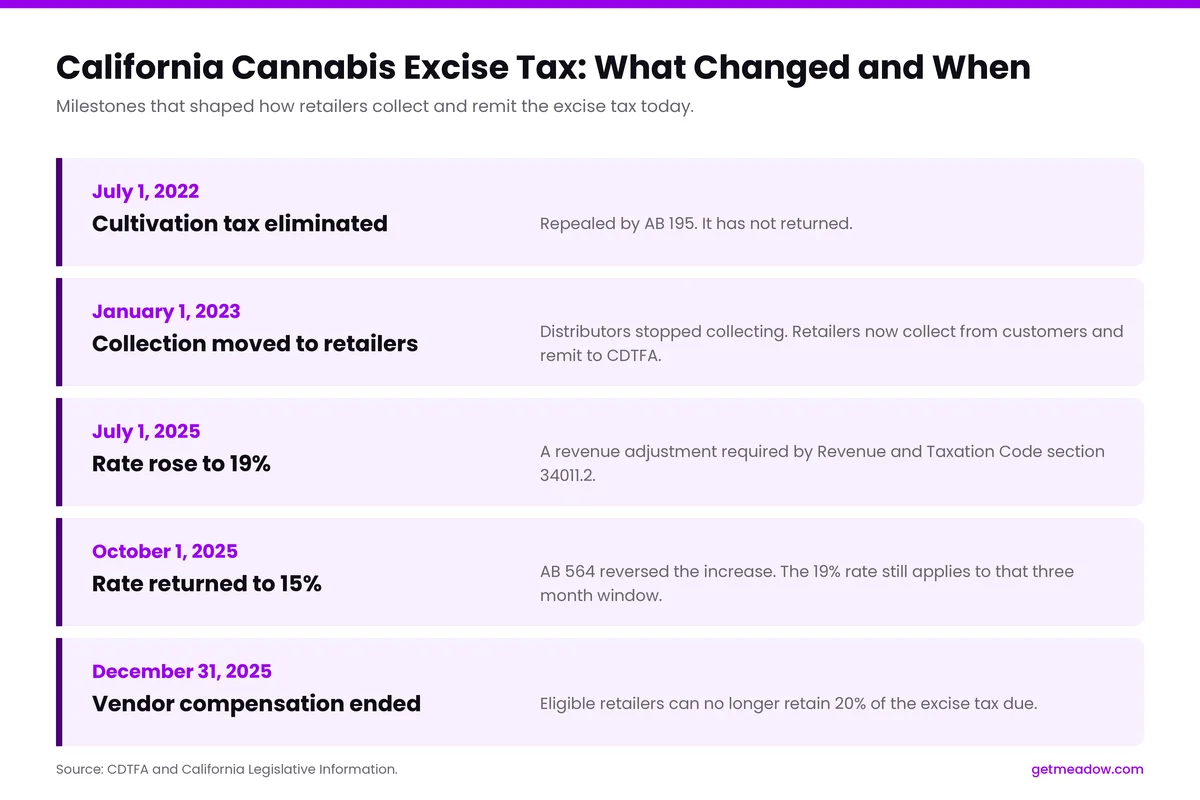
Four things have changed since retailers took over collection, and three of them are now closed.
The cultivation tax ended and has not returned
AB 195 eliminated the cultivation tax effective July 1, 2022. It has not come back. CDTFA reports roughly $500.6 million in cultivation tax collected through that date, and nothing since.
The rate moved twice and is back where it started
The excise rate rose to 19 percent on July 1, 2025 and returned to 15 percent on October 1, 2025, with the 19 percent rate still applying to sales inside that window. The mechanism behind the change, the full rate timeline, and how to apply a rate to a given period are covered in California Cannabis Excise Tax: How to Calculate It.
Vendor compensation ended December 31, 2025
The vendor compensation program let retailers approved for a DCC equity fee waiver retain 20 percent of the cannabis excise tax due on their retail sales. Per CDTFA Special Notice L-998, the program ended on December 31, 2025, and no legislation has extended it. Vendor compensation cannot be retained on sales occurring after that date. The last returns it could apply to were the December 2025 monthly return and the fourth quarter 2025 return.
If you were an approved participant, the program is over. If you have never heard of it, there is nothing to apply for.
The pre 2023 distributor credit is effectively exhausted
Retailers could claim a credit for excise tax already paid to a distributor on inventory purchased before January 1, 2023 and sold at retail afterward. CDTFA's return still includes a field for it, and the supporting records still matter if an older period comes under audit review. In practical terms, inventory purchased before 2023 has long since sold through.
Operators who went into that transition with clean reporting had a materially easier time of it:
Meadow is always a step ahead. With the recent CDTFA excise tax collection change from vendor to retailer, Meadow prepared a report knowing this change was coming that made filing SO much easier on my end.
Julie G., Director of Operations, Vallejo Holistic Health Center & Eagle Eye Napa
Closing Thoughts
The collection model has been stable since January 2023. What has moved is everything around it: the rate, the vendor compensation program, and the credits attached to the transition.
The next scheduled change is the fiscal year 2028 to 29 rate review, and AB 564 requires the DCC, working with CDTFA and the Legislative Analyst's Office, to report to the Legislature by October 1, 2027 on how the Cannabis Tax Law is affecting the regulated market. That report is the thing to watch, because it will shape what happens to the rate afterward.
Filing requirements, penalty exposure, and rates change. Confirm current requirements with CDTFA and work with a cannabis CPA before you file.
Common Questions
Who collects the cannabis excise tax in California?
Cannabis retailers collect it from their customers and remit it to CDTFA. This has been the case since January 1, 2023. Distributors collected the excise tax from retailers before that date and no longer do.
Do I need a separate permit to collect the cannabis excise tax?
Yes. You need a cannabis retailer excise tax permit from CDTFA, which is required in addition to your sales and use tax account. Retailers licensed with the DCC during the 2023 transition were registered automatically, but new licensees should confirm their registration.
When is the California cannabis excise tax return due?
The return is due on or before the last day of the month following the reporting period. New accounts are generally assigned a quarterly basis, so a period ending March 31 has a return due April 30. A return is required for every period, even one with no taxable sales.
What is the penalty for paying cannabis excise tax late in California?
The Cannabis Tax Law imposes a mandatory minimum penalty of 50 percent of the unpaid cannabis excise tax. A 10 percent penalty for a late return or late payment can apply on top of it, plus interest. Relief for reasonable cause requires filing a signed statement with CDTFA.
Is the cannabis vendor compensation program still available?
No. The program, which allowed eligible retailers with a DCC equity fee waiver to retain 20 percent of the excise tax due, ended on December 31, 2025. No legislation has extended it.
Can I be held personally liable for unpaid cannabis excise tax?
Under the enforcement provisions added by AB 195, CDTFA may hold an officer, member, manager, partner, or other responsible person personally liable for unpaid cannabis tax. Discuss your specific exposure with a cannabis CPA or attorney.
Stay Compliant Without the Manual Work
Excise tax collected, gross receipts by location, and the reporting period breakdowns you need at filing time should come out of your system rather than out of a spreadsheet. Meadow has been building cannabis retail software since 2014, and California operators use it to keep collection, receipts, and reporting aligned.
More Resources for Dispensaries
- California Cannabis Excise Tax: How to Calculate It
- How to Choose the Best Dispensary POS System in California
- What Dispensaries Need to Know about Schedule III Cannabis
- Why Integrated Cannabis POS Software Is Essential for Compliance
- CDTFA Tax Guide for Cannabis Businesses
- CDTFA filing instructions: Cannabis Retailer Excise Tax Return
- CDTFA Special Notice L-998: Vendor Compensation Ending
- CDTFA Special Notice L-874: New Responsibilities for Cannabis Retailers
- Full text of Assembly Bill 195
- Full text of Assembly Bill 564
